Reporting current to 5 November 2026.
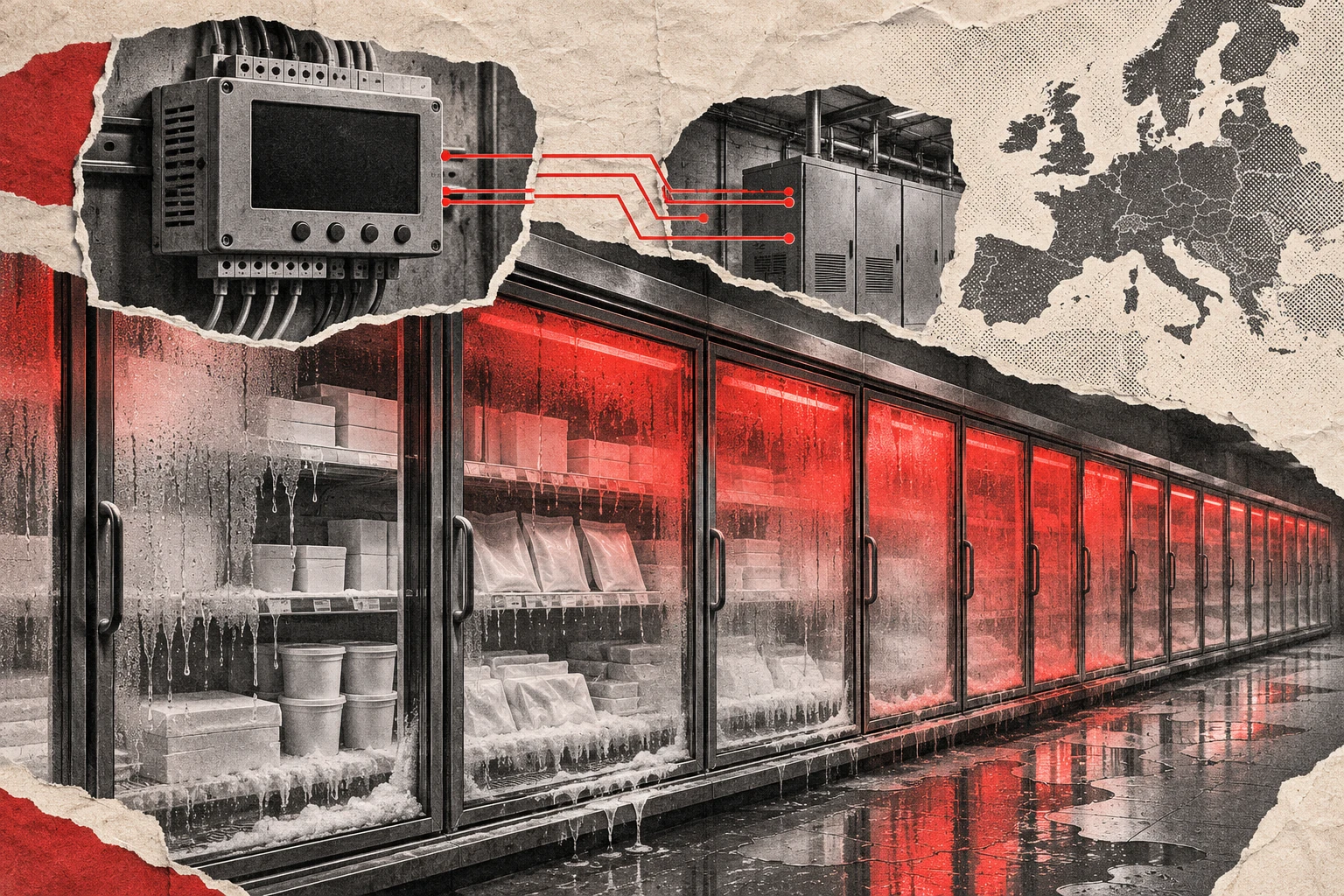
While much of Europe slept, someone was changing the temperature of refrigeration installations. On 2 November, supermarkets in several countries woke up to cooling failures and food that had to be taken off the shelves. At one Swedish store, managers reported that their freezers had reached 50°C. Something similar had happened in France roughly three weeks earlier. [source]
The headline needs an important qualification: the affected installations belonged to supermarkets and other businesses. This episode does not show that an attacker heated up readers’ household fridges. What it does show is that equipment designed to preserve food can become a means of sabotage when outsiders can reach its controls.
The strongest confirmation of the first episode comes from CERT-FR, the response team at France’s cybersecurity agency. Its alert, published on 12 October and updated on 16 October, documents multiple compromises of Danfoss AK-SM and AK-SC controllers, as well as Copeland and Dixell XWEB systems. The notice identifies the affected equipment and calls for configuration reviews, especially of defrost schedules. [source]
To understand the attack, look behind the refrigerated display. These installations have controllers that bring together temperature readings, alarms and operating settings. Some include a web panel that technicians can use to manage the system remotely. Claroty’s research into the Danfoss AK-SM 800A describes precisely this centralized management capability. Access to that panel can give someone control over many devices at a single site. [source]
The defrost function explains how equipment designed to cool can produce heat. It removes accumulated ice and is part of normal operation. According to Claroty’s analysis of the incidents, attackers manipulated these controls to force cycles that raised temperatures and damaged stock. They did not need to physically alter the cold rooms: they could abuse administrative functions that were already available. [source]
That does not make 50°C a universal measurement. It is a temperature reported at particular premises. It does not establish that every cold room reached that figure, that all the food reached that temperature, or that every installation was attacked in the same way. In an incident involving multiple victims, those distinctions matter.
How did they get in? Direct exposure of management panels to the internet is one documented problem. CERT-FR considers that configuration contrary to good practice and recommends removing the exposure. It also calls for changing default passwords, updating supported equipment and using protected access. These measures describe weaknesses that need fixing; the alert does not provide a forensic reconstruction of every intrusion. [source]
There were also known technical vulnerabilities. In August 2026, Claroty published research into the AK-SM 800A that included an alternative authentication mechanism, called a “code of the day,” which could allow administrative access without knowing the configured password. The researchers documented other flaws too, and reported that Danfoss had released fixes. [source]
But there is a tempting leap to avoid: finding a vulnerability in a product and concluding that it was used in a later attack. Claroty explicitly warns that the specific vulnerabilities its team discovered have not been officially linked to these incidents. A vulnerable product, an exposed panel and a device that has actually been compromised are different pieces of evidence. [source]
Healthcare facilities were affected too. On 4 November, Reuters reported an attack on refrigeration monitoring and control systems at three regional centers of France’s blood service. Alerts allowed staff to move products into other equipment and avoid consequences for blood supplies. Remote access to the affected units had been disabled. That episode broadens the concern, but it does not establish that the same actor was behind the supermarket attacks. [source]
For security teams, the practical lesson starts with a fairly simple question: who can change the temperature from outside? The UK’s NCSC recommends taking an inventory of industrial equipment, checking external connections, removing factory passwords and separating control networks from management and business networks. It also calls for connection logging and recovery planning. This is general guidance for these systems, not a description of this particular attack. [source]
CERT-FR adds a particularly relevant warning: restoring factory settings does not, by itself, solve the problem of an obsolete device that is exposed again without security patches. Restoring the cold and restoring secure control need to happen together. [source]
The perpetrators and their motives had not been publicly identified in the reporting consulted. Nor is there sufficient public evidence to attribute this campaign to artificial intelligence. Presenting a geopolitical theory or a laboratory vulnerability as the definitive explanation would fill gaps in the investigation with a more convenient story, but a less reliable one. [source]
For anyone running a shop, the problem leaves a concrete responsibility. The person maintaining the refrigeration, the person arranging remote access and the person managing security need to understand how the equipment is connected and who can administer it. When a digital setting determines whether stock is still fit to sell, protecting that setting becomes part of keeping the business open.
Sources
- Associated Press: European supermarket fridges got hacked. Again. Here’s what to knowNovember 2026
- CERT-FR: Alert CERTFR-2026-ALE-01212 October 2026; updated 16 October
- Claroty Team82: Freeze the Controller, Defrost the Food9 August 2026
- Claroty: How to Find and Secure Internet-Exposed Cooling Controllers Across Multi-Site Facilities4 November 2026
- Reuters: French blood banks hit alongside cyberattack on European supermarkets4 November 2026
- NCSC: Disruptive cyber activity highlights risk from internet-exposed systems and edge devices27 August 2026
Editorial note: This article draws on public documentation and news reporting. It includes no original interviews and does not attribute the attacks to a specific actor.